Patterns of conflict

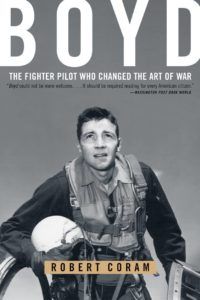
image Regular readers will know that I have an interest in military history.  (See How to improve morale and confidence and Interview with Stephen Bungay.) I’m reading an excellent biography of John Boyd (Boyd: The Fighter Pilot Who Changed the Art of War) at the moment and this has really got me thinking.  I’m going to write a review as soon as I’ve finished it.

In the meantime, I’ve found a version of his masterwork, the Patterns of conflict briefing.

Sun Tzu’s Art of War is sometimes read as a business manual. There are some who think that John Boyd was the Sun Tzu of our age. His Patterns of conflict presentation was a six-hour briefing that is highly influential in American military circles.

Update 14 July 2012. A new version of the presentation is back on Slideshare here and also as a downloadable PDF here. There are also some video clips of the presentation here.

You can also read my review of the book Boyd here.

8 Responses to Patterns of conflict

  1. Jeff June 19, 2008 at 6:25 pm #

    Matthew, while Boyd’s ideas were crucial (I had to learn them in the USMC in the 80′s), the US Marine Corps has crafted a much more interesting document entitled Warfighting. It is a genuine philosophy of conflict and is based on Boyd’s work.

    You might also examine the USMC’s manuals on Tactics and Campaigning. Tactics has an especially valuable chapter on how to get things done faster.

    Having said that, I don’t think business is like war. Business is like diplomacy. It is cooperative and competitive — coopetition. I recommend two books, Arts of Power and Coopetition.

    Now, if I haven’t mangled any of those links, enjoy!

  2. Gary R. Van Horn October 13, 2009 at 10:58 pm #

    I also have recently finished reading “Boyd” and found it fascinating.
    He was another in a long line of military theorists, philosophers and practitioners who have discovered or re-discovered what may be called maneuver warfare.
    I refer to Sun Tzu himself, his descendant Sun Pin, and, anciently, Alexander the Great, the Greeks at Marathon, Cyrus, Belisarius, & Hannibal (at Cannae) among others.

    In the 19th-Century, we could mention Helmuth von Moltke the Elder, Lee and (surprisingly) Grant during America’s War Between the States, as well as “Stonewall” Jackson, Nathan Bedford Forrest and William Tecumseh Sherman.

    During the 20th-Century, we should include military historian and theorist B. H. Liddell-Hart (his strategy of the indirect approach), and certainly Erwin Rommel (in both WWI and WWII), Heinz Guderian, Erich von Manstein and other German generals during WWII.
    The only Allied general of WWII who could be included would be George S. Patton, although recent research indicates that the Soviet General Georgii Zhukov should be considered as a practitioner of maneuver warfare also.

    I admire the USMC and later the US Army for adopting maneuver warfare as part of their doctrine for war fighting.

    Another book that you may find interesting is “The Maneuver Warfare Handbook,” by William S. Lind. Also well worth reading is Chester Richard’s “A Swift, Elusive Sword: What If Sun Tzu and John Boyd Did a National Defense Review?”

    If you have not read it already, Sun Tzu’s “The Art of War” is a classic well deserving of its reputation. Some like the Samuel B. Griffith translation, others prefer the Thomas Cleary translation.

    But these men were the exception. Most nations and their armies slogged away at each other in bloody, exhaustive, protracted attrition warfare, destroying their own countries as well as their enemy’s.

    Gary VH

    • Matthew Stibbe October 14, 2009 at 6:53 am #

      Hi Gary – thanks for the comment on my blog about Boyd. Interesting stuff. As you mention Belisarius, I wonder if you have read Robert Graves wonderful novel “Count Belisarius”. Very good indeed.

  3. Gary R. Van Horn October 14, 2009 at 6:55 pm #

    Not completely, Matthew. I read enough to know that I want to finish it soon. His story complements those of other “Great Captains” of military history.

    Wanting to undersatand what has happened in modern times (19th-Century to the present) I recently read “The Israeli Army,” by Luttwak & Horowitz and several other other books. The ones by Patton and several of the German officers of WWII are especially interesting.

    Searching further on operational-level warfare, I found, and am just finishing, “Blitzkkrieg to Desert Storm: the Evolution of Operational Warfare,” by Robert M. Citino.

    Citino’s voluminous and useful endnotes led me to “A Swift, Elusive Sword: What If Sun Tzu and John Boyd Did a National Defense Review?” by Chester W. Richards (US Air Reserve, ret.)

    (Richards was an associate of Col. John Boyd from 1973 unitl his death in 1997 and has a web site devoted to showing how Boyd’s strategies can be used in business. It is found at http://www.belisarius.com )

    Richards refers frequently to the Thomas Cleary translation of Sun Tzu’s “The Art of War,” but also to the translation by Samuel B. Griffith, which I somewhat prefer.

    I get going on several books at a time, going back and forth for enlightenment and understanding. Maneuver warfare has its roots in the wars of centuries past but saw its most dramatic demonstration by the Germans in 1939-1941.
    ( Germans called it “Bewegungskrieg,” a war of movement, as contrasted to “Stellungskrieg,” positional war.
    The word “blitzkrieg” was concocted by a writer in Chicago in 1940 to describe the startling success of the German offensive that collapsed the French defense and trapped the British forces in Belgium. We all know about Dunkirk, where the British and some of the French soldiers were evacuated but had to leave their equipment behind.)

    Ironically, the Israeli Army is the best know practitioner of blitzkrieg/maneuver warfare in the 20th-Century, although the Desert Storm campaign against Iraq, especially by the Marines, is the most recent example.

    If you want to read the book that “electrified” Gen. George S. Patton and which he was said to have read and re-read, go get a copy of “Attacks,” by Erwin Rommel.
    (Get the recent and complete translation, by J.R. Driscoll, of Rommel’s famous book. Its German title was “Infanterie Greift An,” which was a best-seller in Germany in 1937 and went through 18 printings before 1944. It brought him to the attention of Hitler.)

    I hear that the officers of our armed forces are becoming more familiar with military history, especially the successful campaigns of the past which so frequently involved maneuver warfare, “Bewegungskrieg,” and the “indirect approach.”
    The German terms Auftragstaktik, Schwerpunkt, Aufrollen, fingerspitzengefuhl, and a term that translates into Surfaces and Gaps, are now not unfamiliar to the U.S. military scholar.

    I hope that this is true because, as George Santayana said, “Those who forget history are condemned to repeat it.”

    Gary VH

  4. Jim June 21, 2010 at 11:36 pm #

    FYI his presentation is on slideshare here:

    http://www.slideshare.net/noobgank/patterns-of-conflict

    Hope this helps.
    J

    • Matthew Stibbe June 22, 2010 at 8:08 am #

      That’s tremendous. Thanks for digging that out for me. Cheers, Matthew

  5. Oak DeBerg April 22, 2011 at 10:36 pm #

    Howdy, Matthew,
    I am just completing my dissertation on “War as Aesthetic:The Philosophy of Carl von Clausewitz as the Embodiment of John Dewey’s Concept of Experience.” That’s just a long title that really means “Does the philosophy of Clausewitz have practical (pragmatic) value and does he have anything to offer for fighting contemporary wars?” As a conduit from the early 19th century to the 21st, I am using Boyd’s philosophy as espoused in both his great briefings, “Destruction and Creation” and “Patterns of Conflict,” to suggest that Clausewitz is as germane today as he was 200 years ago. I am positing that Boyd is a reflection of the philosophies of both Clausewitz and the great American pragmatist John Dewey and, since Boyd is the founding father of modern USMC warfighting doctrine, (and presumably the Corps’ philosophy is germane to contemporary warfare), both Clausewitz and Dewey are germane as well.

    Coram’s book is excellent and captures Boyd well. I realize that Boyd was a bit harsh on Clausewitz and Coram gives a good explanation of why Boyd felt as he did regarding the General. However, I think that a closer reading of what Clausewitz demanded of the “military genius” would lead us to the conclusion that Boyd’s “Patterns of Conflict” incorporates more of the General’s philosophy that Boyd readily admitted.

    Otherwise, thanks for the review. I would heartily recommend the book also. I was struck by how well written the work was.

    Thanks,

    Oak

Trackbacks/Pingbacks

  1. Bad Language / Boyd - Book Review - August 19, 2008

    [...] my earlier post about Boyd’s Patterns of Conflict [...]

Leave a Reply