

Proofreading is a lot like eating your five fruits and vegetables a day. It's something everyone knows they need to do, but really? Do I HAVE to?
Basically, yes. There's no sugar-coating those cucumbers.
The good news is with our years of expertise and in the spirit of generosity, we've put together this proofreading guide to make your life easier. We have 24 tips to share (yup, this is a bit of a monster blog post - get settled). But, before we get to that, let’s consider why writing mistakes happen in the first place.
Prefer a video? We recorded a webinar on this very topic. Watch here (slides below as a PDF):

Why do errors creep into writing?
Some of the reasons for making mistakes include:
- Transposition errors and word substitutions. A classic example is ’The medium is the massage’, a book that was initially titled: ‘The medium is the message’.
- Mistakes from not following guidelines. Perhaps the writer doesn't know the rules they should follow or doesn't apply them correctly.
- Errors introduced by technology. If you’re using dictation software, it's not going to be perfect. Editing tools, like Grammarly, have their place, but applying their feedback blindly will lead to issues.
- Inevitable human errors. Then, people just make mistakes - typos, grammar faux pas, whatever. We’re all human. It happens.
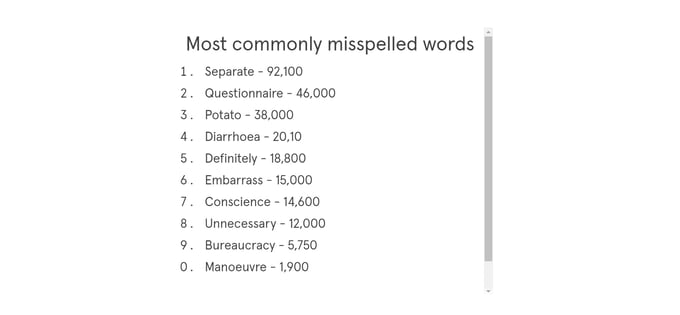
Below are some of the most common misspelled words to watch out for:
Now, let’s consider how you can correct for these challenges and turn out copy that’s squeaky clean.
24 tips for brilliant proofreading
Here's a big ol’ list that’s packed with advice for levelling up your proofreading. Note, these tips are not for stuffy academic writing. They are intended to help you write for the web, which is a whole different ball game. So, follow these tips, and say goodbye to ugly copy.
1. Remove the passive voice
Unless there is absolutely no acceptable active sentence that makes sense, you should delete passive voice. Why? Because passive sentences are harder to read, harder to process, harder to digest. If you can add the words "by zombies" to the end of the sentence, it's probably a passive sentence.
%20(1)-1-2-1.jpg?width=357&name=pexels-cottonbro-5435557(1)%20(1)-1-2-1.jpg)
2. Kill excess adverbs
You know – those words that end with -ly and modify a verb. Well, they aren't usually (haha) necessary. In marketing, we see businesses overuse 'hype' adverbs, 'very' being the main offender. And when people read hype words, they discount your message as a hammy sales pitch.
3. Companies are singular
Oftentimes, you will see people talk about their own business as a plural entity: This is wrong. For example, there’s only one Articulate Marketing. So, it’s correct to say ‘Articulate is a great company’, and not ‘Articulate are a great company.’ (Yes, we think a lot of ourselves.)
4. Use acronyms correctly
You typically want to avoid acronyms that are hard to read or if they're not familiar to everyday usage. If you're writing for an audience that will understand the acronym you’re about to use, that’s fine. Otherwise, acronyms aren’t helpful. If you aren’t sure, spell out the acronym early in the piece.
5. Don’t capitalise words if you can avoid it
Sometimes, we have a client who has every third or fourth noun capitalised because it looks like a technology word or a product word. For example, the term ‘production servers’, might have capital letters. However, this is poor practice. Capital letters are harder to read than lowercase letters. If you don't need them, don't use them.
6. Check for apostrophe usage
The common apostrophe mistakes or confusions are quite often caused by auto-correct. You might've even got it right the first time, but you changed a sentence, and then the auto-correct triggered something. So, understand how to use an apostrophe with singular and plural nouns, and all the other relevant times. Then, you won’t get tripped up by auto-correct.
- Its vs. It's
- You're vs. Your
- There vs. They're vs. Their
7. Eliminate unnecessary punctuation
Exclamation marks and ampersands slow readers down and don’t need to be in subheadings and titles. Just use the word ‘and’. If you put an ampersand in there, that ampersand is going to get more attention from the eye and the brain than the two words it joins. This is not what you want, so don’t use it.
8. Use emojis at the right time
If you look at the Articulate Marketing site, we’re slowly sneaking emojis in there. It’s clearly part of modern communication. In most contexts, it's okay to use emojis, but don't overuse them. Also, remember that older people might not know some of the meanings of the emojis. Consider your audience, and use emojis accordingly 😀
9. Cut out the clichés
We've moaned about clichés consistently over the years. There's plenty of stuff on the Articulate blog about business clichés and technology clichés. Just don't do it. They don't help.
10. Check for consistency
Go through the text and check for consistency. This means consistently talking in the first person or second person if that’s what you started with. In addition, consider how you punctuate bullet lists. This can often vary from company to company, or list to list, even. Some people treat the bullets as punctuation in a longer sentence, so they put commas and a full stop after the last bullet. Others, use no punctuation at all. It doesn't matter which approach you choose, but be consistent.
11. Have a checklist
Another rule for proofreading is to have a checklist. What are the guidelines you should apply? What is an appropriate level of informality? Put this all into a checklist so you don’t forget what’s important.
>> In fact, why not use our checklist? Click here to download it.<<
12. Read like a reader
Don’t forget your buyer personas when reviewing and improving copy. Does it answer their questions? Is there a story that flows and that they’d care about? Does it include any company jargon that they might not understand?
13. Remember the brief
Remember what the piece is trying to achieve, who you're talking to and so on. Make sure you're achieving those goals.
14. Cut paragraphs before you cut sentences
It’s better to change the structure of your piece by deleting low-priority content than it is to try to make all your points but with fewer sentences.
15. Use ‘you’
It’s fine to address your reader directly. It’s also okay to say ‘I’ or ‘we’ to describe the person or company that's speaking. This gets you out of a world of pain when you're trying to find the subject of a sentence and avoid the passive voice.
16. Write with information
If a sentence doesn’t include a fact or make a strong, clear point, it’s a candidate for deletion. Try to add new, unique value to each sentence.
17. Slim down obese copy
One of the easiest and best ways to improve your copy is to cut it down. Shorter, punchier copy is more readable and more memorable. Break down a long sentence into a series of short ones.
18. Double-check short copy
If you've got 10 words, you'd better make sure all of them are correct. However, a typo on page 38 of your first novel is not going to stop it getting published.

19. Give some copy formats extra care
Things like emails need more attention. Why? Because once an email's gone out, it's gone. You can't recall it. It's embarrassing to send out an email and then go, 'Oh, sorry. We made a mistake.' Take the time to get these pieces 100 percent right.
20. Apply time to typos
For some odd reason, you generate word blindness by looking at the text that you've only just written. You can't see your own mistakes. The answer is to go do something else first before you start proofreading. That way, your mind is fresh.
21. Watch out for your own bad habits
There are also bad habits that writers tend to get into. Maybe you use big words, like 'aforementioned'. Whatever errors you regularly commit, recognise your boo boos and be on the watch for them.
22. Print it out so you're proofreading on paper
This helps you see the work with fresh eyes and pick out all the errors. You can also read it out loud to yourself so that you interact with it in another different way. All of these things change the mental process you use to review the text. This allows you to hear or see mistakes you might have otherwise missed.
23. Use proofreading tools
Fortunately, there are many online tools and apps you can use. We love Hemingway. The readability score comes up on the right of the tool, and you get suggestions to improve the text. It picks up passive sentences. It picks up adverbs. It picks up where you should use shorter words. It’s great.
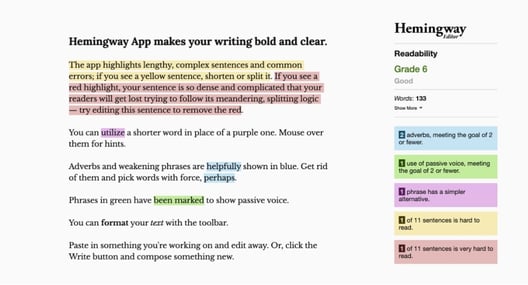
Grammarly goes a little bit beyond Hemingway, and there's a free version and a paid version. It's good at spotting typos and correcting them. Also, it's good at spotting basic grammar layout and text problems, but there's plenty of room for error with it. So, don’t blindly accept its suggestions - you’ll actually start making your text worse.
24. Follow a 3-stage process.
To do a good job, you’ll want to go over the text multiple times. Here’s how a 'three pass' approach should look:
Pass 1: Read through and look at the text as a whole. You want to make sure you have the right content, in the right order with the right tone of voice.
Pass 2: Now, go through and read it for the priority areas. These are the headlines, subheadings, conclusion, and lead. These are where most readers will spend more time, so focus on these.
Pass 3: Finally, work through the text as if you’re zoomed right in with the magnification turned up to maximum, reading sentence by sentence. Look at every word and letter to make things right.
We’re a pernickety bunch when it comes to proofreading
You’ve no doubt noticed that we've got a lot to say when it comes to proofreading. Years of blood, sweat and tears mean we’ve learnt a few things. That’s for sure.
By following the tips we’ve mentioned – everything from using tools to removing clichés – you’ll add little bits of shine to your work. And, in the end, you’ll have the beautiful marble statue that is your finished body of text.
If you’d like to learn more about great writing, grab our free proofreading and editing checklist:

 Matthew Stibbe
We recommend reading these articles, next...

17 sustainable marketing techniques to reuse and repurpose content
Discover how to meet growing demands with a sustainable content marketing strategy. Get tips to...

A comprehensive B2B SEO strategy for better brand visibility
Find out how to embed your B2B SEO strategy in all your marketing and website workstreams, by...

The ultimate guide to persuasive business writing
Persuasive business writing: Articulate Marketing's free guide to getting it right. Improve your...